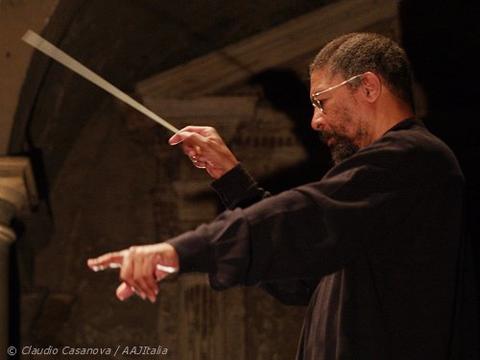
 Witnessing Lawrence D. “Butch” Morris conduct an orchestra, one is subject to sounds and expressions that suggest more than the mere playing of music. Rhythms repeat, clash, build to a crescendo and are swept away in the blink of an eye. Time tilts, as the atmosphere fills with a sense of discovery.
In the last year I saw three of Mr. Morris’ conductions, at Firehouse 12, New Haven’s wonderful venue for new music, and at The Stone and NuBlu here in New York. Varied settings, and quite different casts of musicians accompanied him at each performance. Yet after each, I couldn’t get rid of the idea that Butch Morris made music that felt more like film, moving images edited and spliced with a master’s intuition. It was suggested that I pursue this line of questioning in conversation with the artist.
Following a phone conversation, Mr. Morris emailed me a “manifesto” entitled the Blue Book, published by New World Records as a companion piece to the artist’s series of Conduction CDs released by the label. The first sentence met me squarely: “In 1968 I had this notion that music could be read like a book.”
Witnessing Lawrence D. “Butch” Morris conduct an orchestra, one is subject to sounds and expressions that suggest more than the mere playing of music. Rhythms repeat, clash, build to a crescendo and are swept away in the blink of an eye. Time tilts, as the atmosphere fills with a sense of discovery.
In the last year I saw three of Mr. Morris’ conductions, at Firehouse 12, New Haven’s wonderful venue for new music, and at The Stone and NuBlu here in New York. Varied settings, and quite different casts of musicians accompanied him at each performance. Yet after each, I couldn’t get rid of the idea that Butch Morris made music that felt more like film, moving images edited and spliced with a master’s intuition. It was suggested that I pursue this line of questioning in conversation with the artist.
Following a phone conversation, Mr. Morris emailed me a “manifesto” entitled the Blue Book, published by New World Records as a companion piece to the artist’s series of Conduction CDs released by the label. The first sentence met me squarely: “In 1968 I had this notion that music could be read like a book.”
I immersed myself in the rest of the Blue Book—during which time The Herb Alpert Foundation named Mr. Morris the recipient of its annual Alpert Award for artistic vision and contribution to contemporary life—and eventually we were able to sit down together in Tompkins Square Park and enjoy: a conversation; the sounds passing by us; and the many friends of Butch’s who stopped to say hello that afternoon. I discovered, in fact, that Butch Morris is not in any way a movie-maker amongst musicians nor obsessed with the aforementioned notions of ‘reading music like a book.’ Rather, to spend time with Butch Morris is to observe that every time he raises his hands, there is music.
Butch Morris will be conducting “A Chorus of Poets” on October 7th and 8th at Brechtforum, and on October 14th will be at Cornelia St. Cafe as part of the New Trumpet Underground festival.
This article first appeared at Gathering of the Tribes.
First off, congratulations on the Herb Alpert award! When did you find out, April?
Yeah, probably in the third week of April, second week of April.
Does this [award] change your plans for the year—how long do you have to be [at CalArts]?
It’s a week-long residency. That’s the only mandatory thing that accompanies the award. You go out and do something, and you can pretty much do whatever you want, and from what I understand, I made a proposal to them, and I’m actually still waiting for the answer…it’s best that I don’t say anything about it until I know it’s going to happen.
But I’m certainly looking forward to being out there. Actually I spent many, many years right across the street from it, my family used to own land across the street from where it was built and we used to go up there on weekends and holidays, so I know that area, Valencia, California—or Val Verde, anyways—I used to know it pretty well, until I was about seventeen. That was the last I went out there—no, that’s not true, I went out there in 1971 because a friend had a trailer there, I went to hang out with him.
I’m looking forward to it, I’m looking forward to having a well-rehearsed ensemble in the United States. It should be a thrill.
You’ve written about nostalgia being a source for some of what you do. Going back to a place [like Val Verde] where you’ve been before, is there a musical nostalgia you tie to that area? Or do you always reach further back?
Not necessarily, but I won’t know until I get there. I have no rhythms or melodies tied to that place or anything like that but you know, I am fond of listening to conjure up old things rather than new things. I would still rather hear some Platters or Ink Spots or even some Marvin Gaye before I play anything else, because it puts me in a place, it gives me a date or time.
Structure…
Yeah, it gives me a certain kind of thing. Even though my thing is going to veer off from that, there’s a lot of food in there for me.
You got all them nuts man, give up some nuts! [Interruption as friend on bicycle approaches with cashew-filled sack]
This idea of nostalgia…I’m fascinated by some of your hold cues—
Hold cues.
When you’re telling musicians not to play?
Yeah, but that sign means to yield because there’s going to be some new information coming. Now when I’m conducting and I’m stopping people like [gesture], that’s part of a sign called panorama. It’s like I’m assigning their physical area and we’re in the panorama. When I can be stopping someone, and as soon as I leave they start.
Yeah, you’re creating space in the music. And when you do that, and you talk about nostalgia, I wonder if you’re leaving room for something else that you’re hearing in your head, that maybe the musicians aren’t always playing yet.
Mmm, not necessarily, but I mean often—but on the other hand, yeah! Because even when I’m stopping them I’m hearing something, actually what I’m hearing is telling me when to let them go. Not so much what’s happening in that space, but when will be the correct time to release that sound into the room, that’s the way I see it more. I’m hearing this continuum of sound that’s going by and I stop it, and I’m hearing—it could be the rhythm that’s going on in the room or it could be something going on in my head.
You definitely pick up on the crowd, the architecture, all of that…
I try to, yeah. Often we use information that comes from the crowd. If we’re waiting to start and I’m not sure how I want to start and somebody in the crowd goes [gesture]—I take that information and I move it right on to the ensemble. Or if I hear a door slam or if I hear footsteps or something like that I tell the ensemble to repeat that sound and we use that sound as the motive to start developing the information.
One thing I really enjoyed about the show at NuBlu is there was different music being performed before you, some hip-hop acts from L.A. and Detroit, that left a different audience at 12:30 AM when you guys were getting on than might have been at some of your other shows. I felt your music spoke to that audience as well, perhaps created a…vibe that I hadn’t heard [in other recent performances].
I use the musicians for what they do. I never tell them you can’t play this or you can’t play that. I just say you do what you’re going to do within the context of what I do. You supply the content, I supply the structure. If I say “repeat,” I don’t care if it’s a hip-hop repeat or a jazz repeat or classical—I don’t care where it comes from, just give me some information and I’ll do something with the information, but you’re repeating. No matter what your cultural or stylistic background is, you have to give some information to me that repeats. If I say “sustain,” I don’t care what the sound is as long as it’s a sustained sound. If I say anything else—it’s gotta come from you.
I never ask anybody to play over their heads. Hopefully I can create some kind of momentum in the music to push you over your head, but I’m not asking—if I say “play,” I just want you to play what you play. I’ll take something from what you play and I’ll start distributing.
One thing I like about that is there’s this generation shaped by DJ culture, and there’s something about what you’re doing that’s like being a DJ, and that speaks to the mindsets of some of the musicians you’re working with.
Well I can’t say it speaks to the mindsets of the musicians because half the time they don’t know what they’re in for. Especially at NuBlu. A lot of times people are new and don’t know what’s going on, but if I agree to let them play I try to work them into the ensemble. What I’m doing takes a lot of patience. A lot of cats want to sit in but don’t know it takes a lot of discipline to be a part of that ensemble, or any ensemble. Two weeks ago I conducted this kind of electro-acoustic jazz ensemble, then I went to work with this classical ensemble, then I went to work with this free jazz ensemble and all the music was different simply because there are all these different histories going on and every time I go like this, or go like this, I’m using the same signs and gestures with all of them, but they’re giving me all different information. That’s what’s so interesting for me, and for them once they get it, but they gotta get it. It’s not something you can fake.
Like, a lot of times, musicians are thinking “I’m gonna improvise my way through this” and I’ll say “what are you doing?” because at every point the musician has to know what they’re doing. They’re either developing a repeat or they’re developing something that has happened, something that is part of the gross product of what we’re doing. Some people think “I can just improvise over the top of this,” and that’s bullshit. I don’t let that happen. I call ‘em on it and say “what are you doing?” And if they can’t tell me what they’re doing, precisely what they’re doing, they’re bullshitting me and they’re bullshitting the music.
I know you say you may not still believe everything you wrote in the Blue Book, yet early on you said there’s a definition of a musician as being somebody who has surrendered to sound or at least to those sounds that make them tick. I was wondering if there was any way you can put into words, you know, the certain sounds that make you tick?
I think I’m in touch with the sound within me. The sound within me is a huge definition of what I might consider music. I’m in love with a lot of things. Music is a lot of things to a lot of different people. I hear a chorus of angels in an idling ’59 Buick, know what I mean? There’s all kinds of stuff—that sound right there, that acceleration [of a passing car], there’s all kinds of information that makes me…you can tell what kind of lighter that is, that Zippo [of a passing pedestrian] just simply how it closes. Information, it tells you stuff. The prop flying overhead. There’s all kinds of stuff, and that drives me. That bongo player, the bike going by, the car there—Nore! [waves to friend]—how you put things together, that makes me tick. But for other people—like you—it’s certain sounds, the sound of that or the sound of that. It’s not so much that for me it’s how we make sense, how we can sit here in the park and put all these sounds together, with our eyes closed. It becomes this huge, symphonic thing, you know?
And when you pointed out the propeller in the sky, [on the street] there was a bad wheel going another way, yet they were with each other.
Everything, everything—on the other hand, you know, I’m in love with early R&B, I love R&B. I love R&B because it drives me. It’s something of my childhood, something that takes me right back, and it’s very interesting and I use it as a source.
You talked about Marvin before. Is there a certain period of Marvin that gets you?
His early stuff, but I like it all. I like his last stuff, I really like the way he brought layers and layers and layers…
I love that period between What’s Going On and Let’s Get It On. That song “You’re the Man”—
I love that stuff too. Amazing stuff.
Do you think ever about the general effect of the vibrations of music on the world about you, just putting them into the air when you do a concert?
Rarely. I don’t know because I don’t think about it. I guess if I sit and think about it—yes I have thought about it, but it’s not something I think about.
I’m always curious about people in the audience who may not expect to be there and aren’t initiated into the music and yet they hear it.
Yeah, well, I’m always trying to convert somebody. People who say they don’t like jazz or they don’t like free jazz or avant-garde or…I’m always looking to convert them, yeah. That, I’m always interested in. I’m always interested in why somebody doesn’t like—because labels are something else, and ‘styles’ are something else. Somebody will say “Oh, you play jazz.” And I say “yeah, I’m a jazz musician. But I don’t know if what I do would be called jazz.” I’m a jazz musician. Yes I am, but listen to this and tell me, what do you think? Oh that’s not jazz? Tell me why it’s not jazz. Yeah, I don’t necessarily call it jazz, but I am a jazz musician. That’s a very interesting thing.
Whenever folks say “that doesn’t swing,” I wonder, well, why can’t you[they] swing with it [the music]?
Well, I figured out a long time ago that there was one thing really more important than swing in jazz, and that was the essence of swing. If those elements aren’t in place it won’t swing and that is a fact. Now whether somebody wants to deal with that fact is another thing, but that is a fact. If spontaneity isn’t in place, if momentum isn’t in place, if combustion isn’t in place, it’s not gonna swing. But I figured out how to take those elements and use ‘em to, as far as I’m concerned—let me just say, I figured out how to take that essence of swing, and use it in another way, and figured out how to get an ensemble to swing in a totally different way.
Yeah you did. You’ve worked with a few other conductors?
You mean taught them?
Yeah, I mean is that something that's important to you, that you have somebody who gets what you’re doing and is doing it in their own way?
Yeah, that’s very important to me but I’m not trying to push that on any faster than it’s going to come. I mean, one of the people that’s worked with me the most is J.A. Deane, and he is doing a marvelous job at finding and having his own identity at it. And I’ve seen other people who have their own identity at it too. Some people have a totally different style that’s called something else, like Walter Thompson [whose form is called “soundpainting”]—and that’s lovely too, it’s beautiful. What’s interesting about the people I’ve seen do anything like conduction or soundpainting—everybody’s making their own music. No two musics sound the same.
That is great, but it’s like I’ve said for years—conducting is a tool. You use it like somebody might use a string instrument or a wind instrument: you find your identity within it and you make your music with it. I have not once complained that somebody else is conducting. That is for everybody to do. I’m always happy when I see somebody else conducting, and it sounds like them, and they don’t sound like me.
Do you feel people are going to carry [the tradition] on?
They have to. That’s one of the points I’m trying to make. What I’m doing has basically been around since 2700 B.C. There are cave drawings of it…there’s documentation that there were people who sat in front of ensembles and conducted sound. Now, even in the dictionary of conducting they have documented how some of this was done. But this time, because the growth of this runs concurrent with—as you said—DJs, and turntablism, and the internet, it opens the door for a lot of new music to be made. A lot of new music to be made, and a lot of old music to be reinterpreted. You know, the classical music market has never been as destitute as it is today—
—is that necessarily true? Now in the digital download age I’ve heard the market is not nearly as dead as people thought it was.
I’m talking about the CD and record market. But maybe it is coming back. Still, perhaps it’s just that a lot of people need an education and want to go back and listen to that stuff. Classical music has not expended its wealth yet. There’s still room for a lot more interpretation.
And there’s still a lot of classical music people haven’t learned to hear.
[under his breath] Well, there are still a lot of classical musicians who haven’t learned to play.
[laughter] I’ll delete that.
Ah, I’ve said it before. There’s a lot of people that carry instruments, who are not creative. A whole lot. A lot of musicians get involved in music for some pretty strange reasons.
How many times have you performed the Chorus of Poets?
I’ve been doing it for 14 years. Steve [Cannon] and I started it, actually in 1989!
Were there certain sounds you were looking to hear? Not words but sounds?
I was looking to hear words and sounds. I was looking to hear a new description, a different poetic description, a different dramatic description. I started working on it for one reason, but then Steve said, ‘aw man, we gotta do that with one of these plays’ and we incorporated it into one of his plays. And then I did it with 4 or 5 poets. And then we were asked to do it for the New Year’s celebration at the Whitney…I was asked to do something, and I decided to take 18 poets up there. It was a wonderful concert, and I’ve been doing it almost every year since, at least once. I haven’t done it yet this year, I’m supposed to do it October 7th and 8th at the BrechtForum. I’m looking forward to that because what I’m actually going to be doing there is the UnaBomber’s Manifesto. I’m doing it as the soundtrack to a film.
How did you get involved with that?
A friend of mine was doing a film, Howard Monath. He wanted me to do some music for his film, and when I read the script I said “you shouldn’t really do music, you should do the Chorus of Poets.” Then I let him hear the Chorus, and he said “yeah, this is great.” Then I took this text and I started arranging it for the chorus to read. But what we do with that text will be something else.
I don’t have much of a reference point for it. I always liked Luciano Berio’s Eindrücke (Impressions). There was a certain kind of tension that was created in the rise and fall of the voices, and the narration.
The voice is still the most amazing instrument…there’s still a lot of music to be played. I feel like it’s one of the most exciting periods of my life.
Like you’re just getting started!?
No, there have been other exciting periods. But I feel like this is a very, very important period in my growth and a very important period in music—if people pay attention. Like I said, there’s a lot people don’t want to pay attention to. I think this will be something that sooner or later people are going to have to pay attention to. I mean, not only what I’m doing but there’s a lot of stuff happening out there. There’s a lot of beautiful music happening, all over the world. And I’m not talking about something that’s stylistically clear, like it’s world music or it’s jazz…it’s stuff that you can’t put your finger on. Not just some weird shit, there’s some doors opening to some very grey areas, and I think those areas can be a world of discovery.
You find out about most new music through interaction, through working with—
Yeah, definitely.
That gives you an interesting perspective, in that you kind of see the creative process, even if you’re primarily interested in the end result and what to do.
Not in a very deep way. If I get to know that person, yeah. I mean, I just worked in Italy with a 22 piece ensemble and I didn’t know those musicians and I didn’t know how it was going to go. But the more I coaxed that out of them, the more they gave to the music, the more I understood about where they liked to go. It’s interesting, I don’t know their process. I can know a little bit about their history by listening to them, but knowing someone’s creative process can be a very, very difficult thing. If you see me on the bandstand playing my cornet with some band, you have no idea that my love is conducting. But my true love is music.
I think you have another love—dancing! When you’re conducting, there’s a lot of dance involved.
Well, you’ve got to try to do your best to get out, what you want to get out. If I have to move, I have to move!
Sometimes are you not satisfied with the terms you’re ‘supposed to’ use—intuition, improvisation, et cetera?
Sometimes. Improvisation is certainly one of the terms I’ve overused in the past. In some cases, [musicians] walk out [of one of my ensemble’s rehearsals] and go “I can improvise now.” That’s bullshit—you can’t improvise. You’re just interpreting symbols, using one’s intuition. Getting in touch with one’s intuition or one’s intellect or one’s will—these are very important things in the creative process. Now how they put that to use is another thing.
Do you read anything off-topic these days?
I don’t read novels, and I’m not a big movie fan. I read stuff for information. Plus, I’ve got enough material—[pulls out a small black leather book] I fill one of these books every two months, I fill it with notes, and graphs, and…I’ve got to keep up with what I’m thinking.
Like figuring out a puzzle.
That’s what music is, trying to put together a puzzle.